2013/11/07

Higher than the Mont Blanc


Now I know.... 4910 meters is really high. Going to the Colca canyon you cross a pass this high. The Mont Blanc, the highest mountain of Europe, is 4810 meters high.
Already in Arequipa at just more than 2000 meters our legs were "heavy".  The guide told us to to prepare for the heights. First thing to do is to chew coca leaves.


Take some leaves, fold them and make them wet and soft in your mouth.... then take some more. You end up with a lump of more or less soft coca leaves in your cheek. Refill during the day.
Personally I can think of something more tasty to chew..... In the Andes regions grandmothers teach their grandchildren to chew coca leaves. They "pre-chew" a portion of leaves and put it in the children's mouths. It helps people to function at these great heights.

Leaving Arequipa we said goodbye to El Misty (the perfect Volcano).


A bit further down the road there is a huge cement factory (the largest of Peru).


We drive through an empty dry landscape.


In the distance we see the Ampato (6,288 meters - the mountain Juanita climbed).


 Because it is so pretty..... just a bit larger.


Along the roadside there are vicuñas. Vicuñas live in the wild, while the other members of the Llama family, alpacas and lamas, are domesticated.


We stop for a cup of coca-leaf tea. The rest of the trip most of us will drink a lot of this tea. We also learn that in order to make the chewing of coca leafs more effective we have to add something black tasting a bit like licorice. A kind of accelerator.


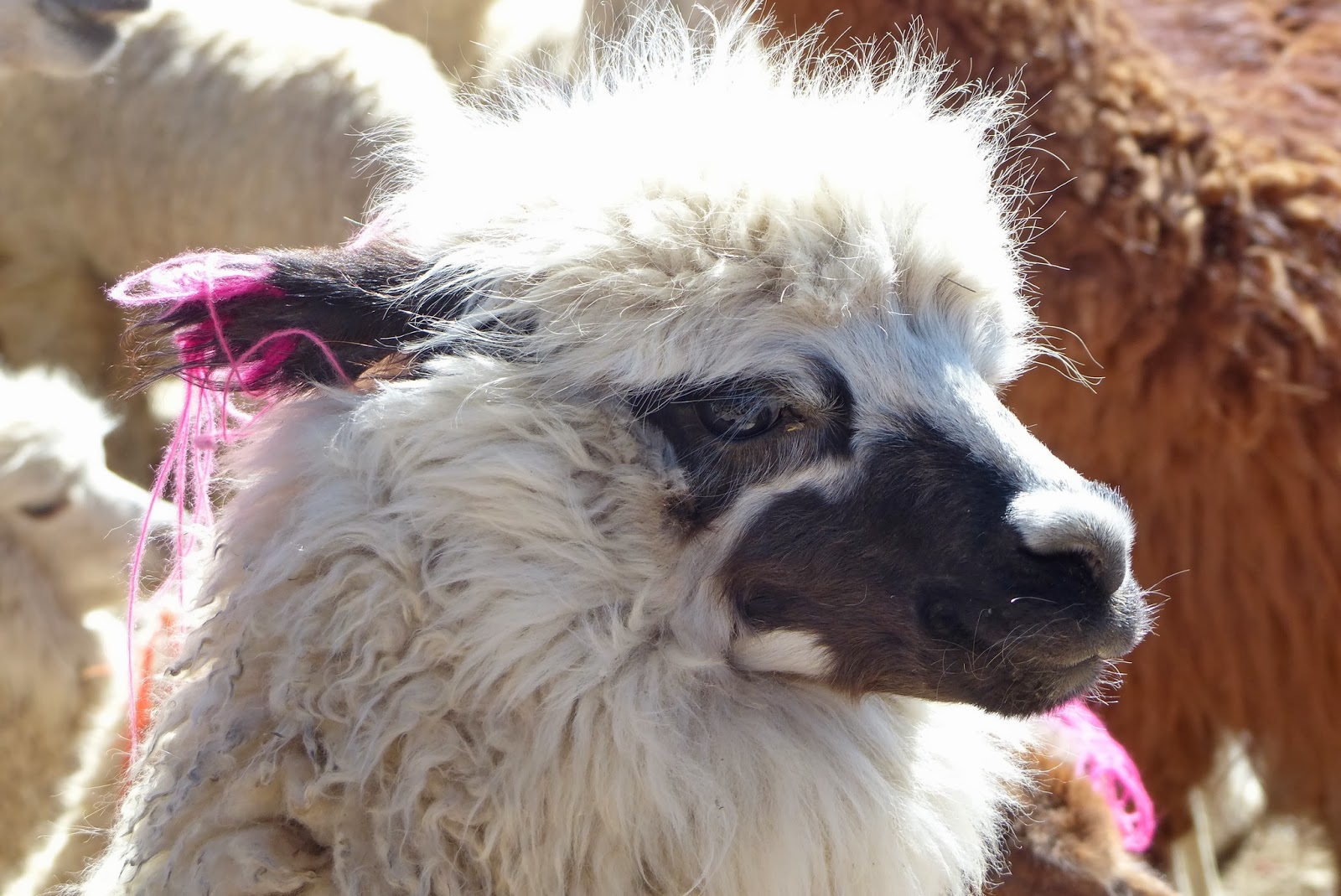
This lama spots some new tourists arriving..... mmmmm food! They love everything.


Across the parking of the restaurant the rock formations look like those in Cappadocia (Turkey).


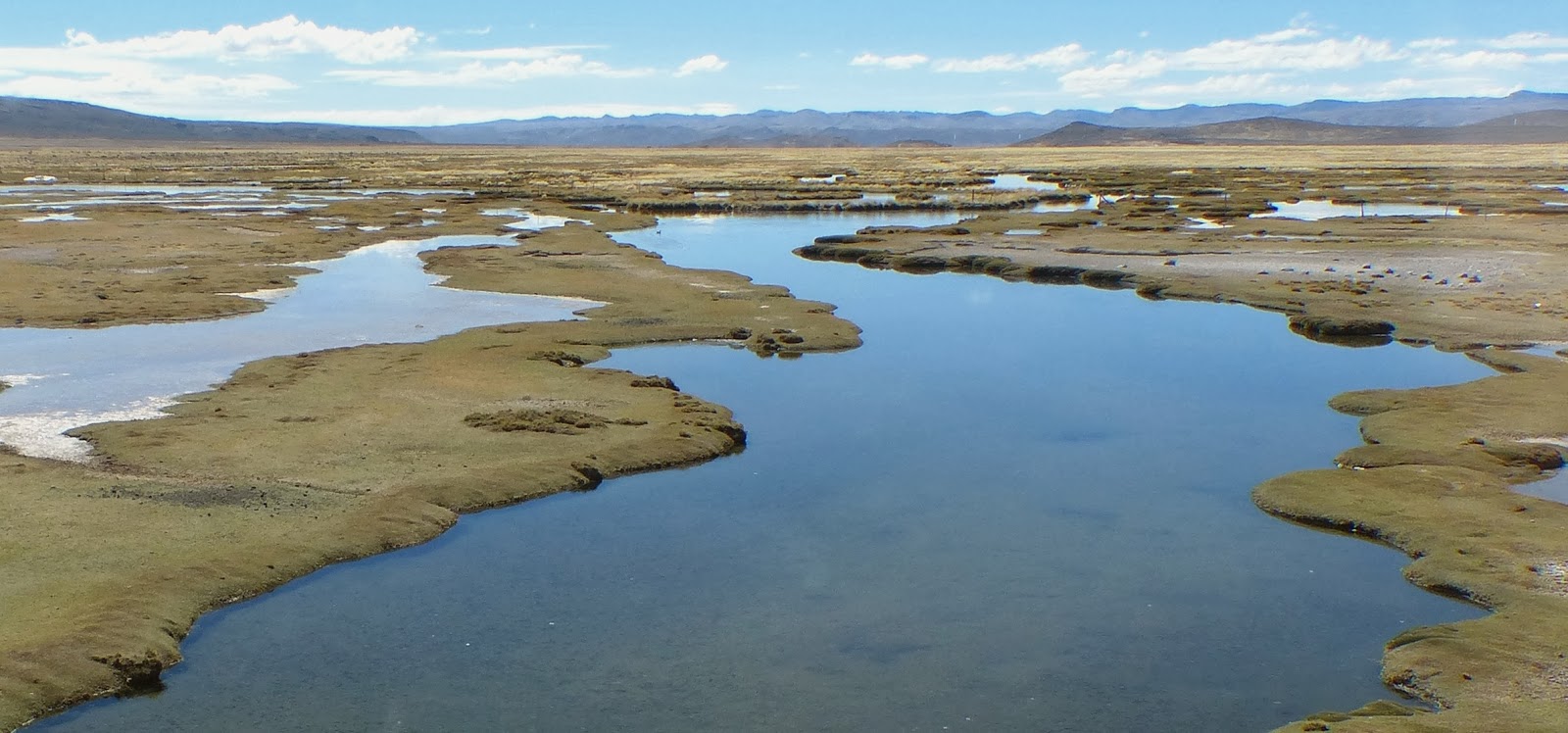
Going further up, the water is partly frozen. A beautiful and desolate landscape.


Now we are nearing the pass. It is cold. Icicles in the shade.


Far from the road a vent with steam.

 Still going higher.....


There we are..... 4910 meters high on the volcanic ridge of the central Andes.


The view is overwhelming, but imagine sitting there all day in the burning sun and cold air. Waiting for tourists that have difficulty even standing.


This road is going now into the Colca Valley. Pampas de Patapampa.... Would the name of the pass be something like Passa de Patapampa? I didn't see a sign anywhere.


Ohhhh, how did they do it?? On a bicycle!!


 Down into the Colca Valley......


2013/11/01

Arequipa; the convent of Santa Catalina


Imagine being the second daughter of a well to do Spanish family in Peru in the 16th – 17th century….. What would be the perspective for your future….? According to tradition it would be living in a convent as a nun and spend your days in service to the Church. Your position in the convent would depend on the size of your dowry. Well, you would have your own maid and your “cell” would be comfortable (certainly considering how other people lived in that day and age). 


In the convent you can visit the rooms of the nuns. Many rooms are furnished. There is also a  small museum with more valuable pieces.


The convent was a city in the city of Arequipa. The nuns could live there in luxury. 
The narrow streets were named after Spanish cities. Like: Burgos street, Toledo street, Cordoba street....

Toledo street


Cordoba street


Zocodover square
When you climb the stairs to the terrace of the church (your legs let you know that you just arrived at a height of 2000 meters!!) you have a great view of El Misty the 5822 meters high volcano, that towers over Arequipa.


El Misty (5822 m)


This convent is very beautiful. The colorful streets, the little photogenic corners ......


The Cusco school paintings in the arcades of the courtyards.....


Much later in the 19th century the Santa Catalina convent was reformed by the sister of Pope Pius the IX-th into an institution like others.  Most of the treasures were sent to the church in Rome.

It must have been nice to meditate here in these quiet courtyards.....


Although, the washing had to be done.
And let's not forget the cooking....


2013/10/16

The market in Arequipa


Yes this is a market. It is the San Camilo market of Arequipa in Peru. Being thankful in a market-hall so full of beautiful food is certainly a very good idea.


 In this market you will find cheese..........


fish........


meat..................


entrails................


and lots of fruits .............

But when it comes to potatoes and corn, then markets in Peru are very special. 


If somebody just asks you to buy a kilo of potatoes in Peru, you will be completely lost. There 
are so many different kinds of potatoes - some say more than two or even three thousand varieties - that you have to know beforehand what kind of potatoes you are going to buy. All these potatoes have their own fantastic "earthy" colors.


The Peruvians also grow many varieties of corn. Like black corn and white corn and many other colors in between.


And let’s not forget the Lima beans and last but not least the quinoa  Quinoa is not a grain, but a seed (so no gluten). It is (according to the FAO) a food with “high nutritive value”.  The FAO declared 2013 (yes now) “The international  year of the quinoa”.  So if you want to try… on the internet there are lots of recipes for quinoa.  BBC - Good food   Cooking light  allrecipes.com  vegetarian

In a corner of the market, with very narrow passages is the "witches market". The witches don't like you taking pictures of their stalls. They sell herbs, berries and lots of bottles and packages with healthy and healing products. But also other more "dark" things like dried Lama fetuses.


The Lama fetuses are offered to Pachama to bring a good harvest.