2013/11/01

Arequipa; the convent of Santa Catalina


Imagine being the second daughter of a well to do Spanish family in Peru in the 16th – 17th century….. What would be the perspective for your future….? According to tradition it would be living in a convent as a nun and spend your days in service to the Church. Your position in the convent would depend on the size of your dowry. Well, you would have your own maid and your “cell” would be comfortable (certainly considering how other people lived in that day and age). 


In the convent you can visit the rooms of the nuns. Many rooms are furnished. There is also a  small museum with more valuable pieces.


The convent was a city in the city of Arequipa. The nuns could live there in luxury. 
The narrow streets were named after Spanish cities. Like: Burgos street, Toledo street, Cordoba street....

Toledo street


Cordoba street


Zocodover square
When you climb the stairs to the terrace of the church (your legs let you know that you just arrived at a height of 2000 meters!!) you have a great view of El Misty the 5822 meters high volcano, that towers over Arequipa.


El Misty (5822 m)


This convent is very beautiful. The colorful streets, the little photogenic corners ......


The Cusco school paintings in the arcades of the courtyards.....


Much later in the 19th century the Santa Catalina convent was reformed by the sister of Pope Pius the IX-th into an institution like others.  Most of the treasures were sent to the church in Rome.

It must have been nice to meditate here in these quiet courtyards.....


Although, the washing had to be done.
And let's not forget the cooking....


2013/10/16

The market in Arequipa


Yes this is a market. It is the San Camilo market of Arequipa in Peru. Being thankful in a market-hall so full of beautiful food is certainly a very good idea.


 In this market you will find cheese..........


fish........


meat..................


entrails................


and lots of fruits .............

But when it comes to potatoes and corn, then markets in Peru are very special. 


If somebody just asks you to buy a kilo of potatoes in Peru, you will be completely lost. There 
are so many different kinds of potatoes - some say more than two or even three thousand varieties - that you have to know beforehand what kind of potatoes you are going to buy. All these potatoes have their own fantastic "earthy" colors.


The Peruvians also grow many varieties of corn. Like black corn and white corn and many other colors in between.


And let’s not forget the Lima beans and last but not least the quinoa  Quinoa is not a grain, but a seed (so no gluten). It is (according to the FAO) a food with “high nutritive value”.  The FAO declared 2013 (yes now) “The international  year of the quinoa”.  So if you want to try… on the internet there are lots of recipes for quinoa.  BBC - Good food   Cooking light  allrecipes.com  vegetarian

In a corner of the market, with very narrow passages is the "witches market". The witches don't like you taking pictures of their stalls. They sell herbs, berries and lots of bottles and packages with healthy and healing products. But also other more "dark" things like dried Lama fetuses.


The Lama fetuses are offered to Pachama to bring a good harvest.


2013/10/03

Arequipa, the white city.

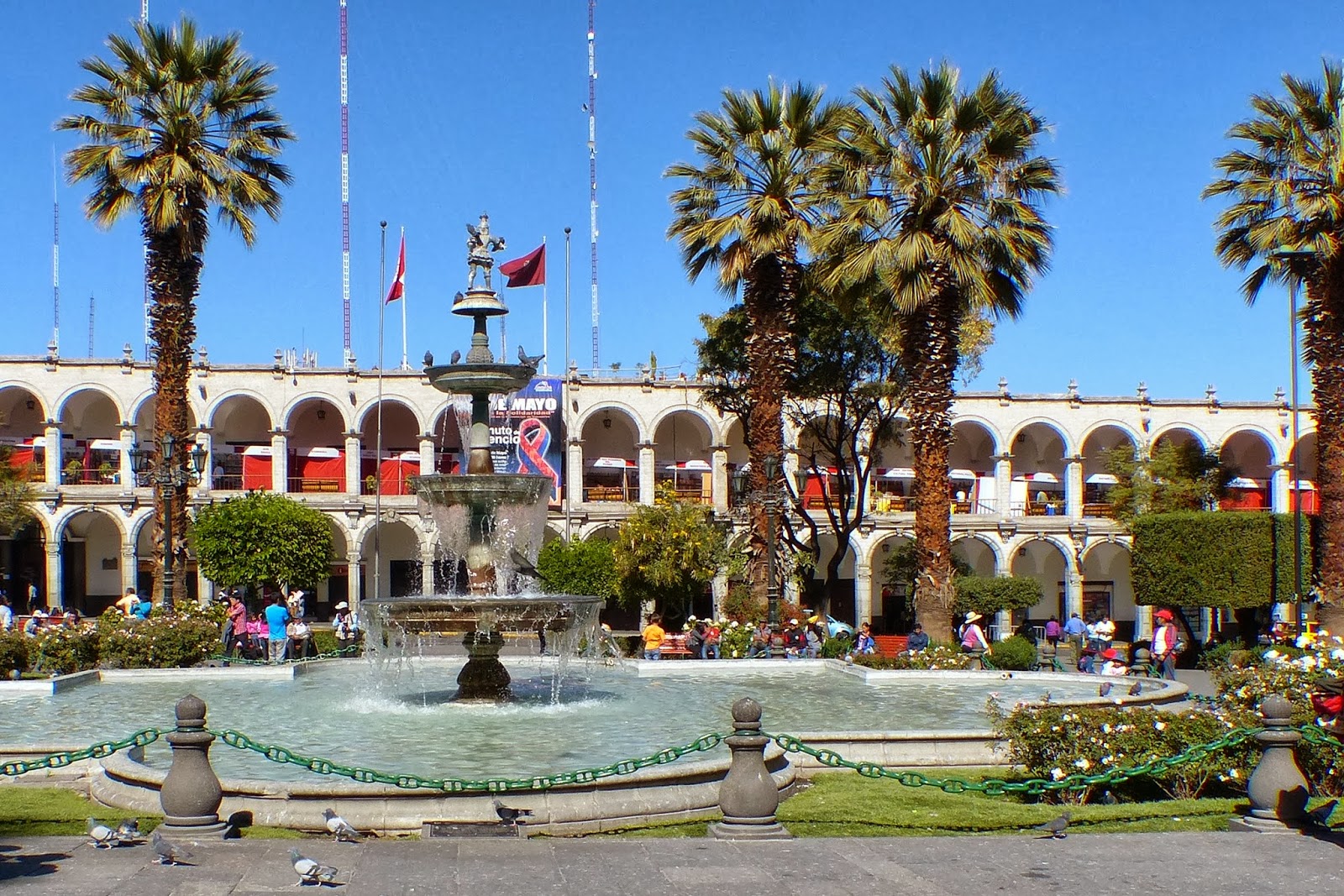
Arequipa is called the white city because the cathedral, the colonial buildings with colonnades around the central square, the Plaz de Armas, and most of the houses are build with white (very light grey) volcanic stones. In the Peruvian sunlight this looks very bright.


 Entrance of the Cathedral.


We arrived in the morning after a trip on a night bus. So first we had breakfast at the Plaza de Armas in a restaurant on the first floor with a good view of the Cathedral (1612) and overlooking the Plaza.

Every time the towers were damaged by one of the many earthquakes they were rebuilt.


I did my best to get a decent picture of this very, very long front of the Cathedral.


Sitting on the fist floor it is nice to watch the activities in the square.


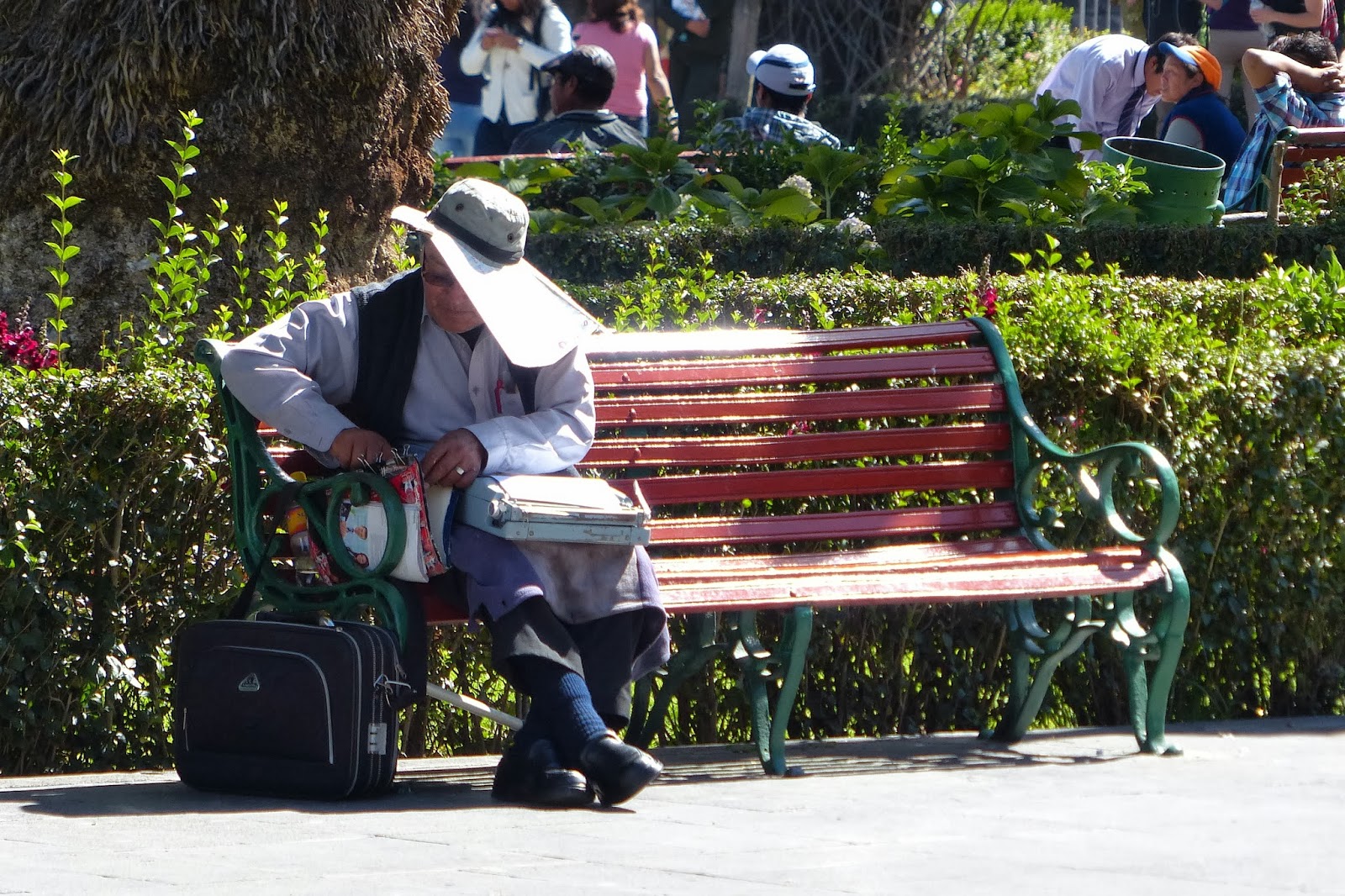
There are lots of people who cannot read or write in Peru. Here in Arequipa they go to the square, where there are some men with typewriters who will write a letter for you.

It is also a good place to read the morning newspaper.

Or to prepare the goods to sell today.

We could stay in Arequipa all day. So we went to see Juanita, the mummy that was found in 1995 on the slopes (near the top) of the volcano Ampato. The girl climbed the mountain 500 years ago as a gift to the gods by the Inkas. It was worth going there, but no pictures (anyway it was far to dark inside to take pictures). Amazing how well the clothes and her body are preserved. Take care to wear a fleece when you go to the museum (Musea Santuario Andinos) it was freezing cold in the museum.

We also went to the market San Camilo and to the convent of Saint Catalina. More about this in the next blogs.

In the evening the Plaza de Armas is even more busy then in the daytime. 


Finally we sat down for some dinner in the small street behind the Cathedral. This day we really noticed that we were more than 2300 meters high up in the mountains. And this was only the beginning.


My companion told me the local beer was just fine.